
"Part 3: The Third Control Layer: How VPPs Change Accountability and Support"
Welcome to the third installment of our five-part series on Battery Boom. In Part 2, we built the minimum viable dataset (MVD) needed to stop guessing and start proving system behavior. Now, we tackle the most misunderstood element of modern battery ownership—and the biggest source of false support tickets: Virtual Power Plants (VPPs).

The VPP Illusion and the "Blame Sponge"
The industry has sold Virtual Power Plants (VPPs) to homeowners as a magic bullet: “Sign up, support the grid, and get paid.” But what the marketing brochures leave out is the operational reality. When a customer signs up for a VPP, they are signing a control contract. They are giving a third party the right to take over their battery, drain it during an evening price spike, or hold its charge when the grid demands it.
And what happens at 8:00 PM when the homeowner opens their app, sees their battery discharging directly to the grid instead of powering their house, and assumes the system is broken?
They don’t call the VPP operator. They call you, the installer. If you don't have the visibility to instantly prove that a VPP event is overriding the local system, you become the default "blame sponge." You'll spend hours on the phone, or worse, roll a $500 truck to fix a battery that is doing exactly what it was commanded to do.

Understanding the "Third Control Layer"
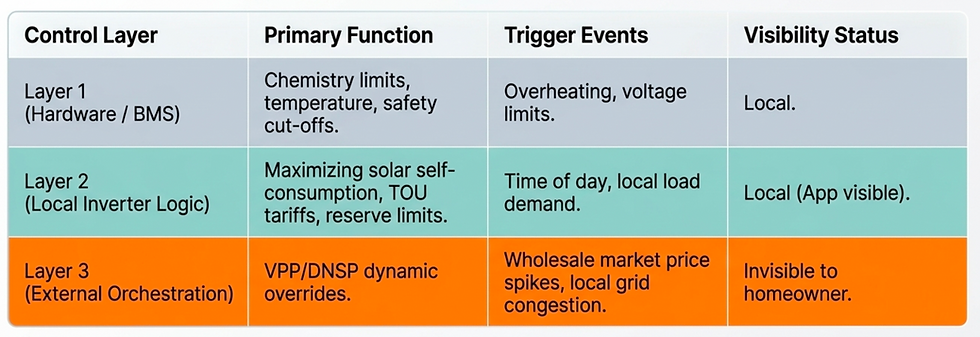
To survive the VPP era, installers must fundamentally change how they view battery behaviour. You can no longer look at a system purely through the lens of local hardware. You must understand the three layers of control:

Layer 1: The Hardware & BMS (Battery Management System). The physical limits of the chemistry, temperature controls, and safety cut-offs.
Layer 2: Local Inverter Logic. The settings you commissioned—typically maximizing solar self-consumption, respecting reserve limits, and managing Time-of-Use (TOU) tariffs.
Layer 3: External Orchestration. The VPP, retailer, or DNSP dynamically overrides Layer 2 based on wholesale market prices or local grid congestion.
When Layer 3 takes over, Layer 2 logic is suspended. If your service team is only looking at Layer 2 data (like basic SOC and solar generation), a VPP dispatch looks exactly like a system malfunction.
Managing Transparency: How to Break the Blame Loop
You cannot stop customers from joining VPPs, nor should you; they are a critical part of Australia’s energy transition. But you must protect your service margins. Breaking the blame loop requires radical transparency and the right digital infrastructure.

1. The Handover Conversation: Expectation management starts at handover. Installers must explicitly educate customers on the throughput-ROI trade-off. Explain that VPPs generate revenue by cycling the battery harder. More cycles mean higher MWh throughput, which equals faster degradation of the State of Health (SOH). If the customer calls in three years complaining about capacity fade, your CRM needs to show they consented to heavy VPP cycling.
2. Visibility into Dispatch Events: When the customer calls complaining about erratic behaviour, your Level 1 support team needs an "Evidence Dashboard" (as discussed in Part 2). Before asking the customer to reboot their router, your team must be able to check: Is there an active API control signal commanding this discharge?

If the answer is yes, the support ticket is closed in three minutes with a simple explanation: "Your system is healthy. Your VPP provider is currently discharging your battery to capitalise on high grid prices."
The Future is Fleet Operations
VPPs are shifting the installer's role from a construction business to a fleet management business. The complexity of third-party orchestration means that "install and forget" is dead.
To protect your margins, your business needs a unified view of your entire installed base. You need to know which systems are enrolled in which programs, when they are being dispatched, and how that impacts their warranty limits.

At SolYield, our platform gives installers the exact operational context required to see the "Third Control Layer." By integrating external control data with local device telemetry, we turn confusing battery behaviour into clear, explainable evidence, stopping unbillable truck rolls before they happen.
Navigating the solar market requires the right tools and insights. SolYield Software empowers solar professionals to automate operations, maximise customer satisfaction, and grow their business profitably with confidence. If you’d like to learn more or schedule a demo, contact us @ info@solyield.com


Comments