
The "Solar Coaster": Digital Automation and Market Evolution


The Australian solar and storage industry is currently witnessing a historic milestone. With installations surging to around ~1,000 per weekday during this peak period, we are seeing the fastest professionalisation of the sector to date .
While the industry has always been known as a Solar Coaster due to fluctuating incentives, the shift arriving on May 1, 2026 is different. It marks the transition from a transaction based install and forget model into a sophisticated Energy Services market. For forward thinking businesses, this isn't a drop to fear, but a massive opportunity to build long term value and secure better margins through efficiency.
Here is how the leaders of the 2026 market are preparing to thrive.
1: Navigating the 2026 Strategic Transition
The upcoming restructure of the federal battery rebate on May 1 is designed to align incentives with right sized systems. While the STC factor will shift from 8.4 to 6.8, the government has expanded funding to $7.2 billion to support over 2 million installations by 2030.
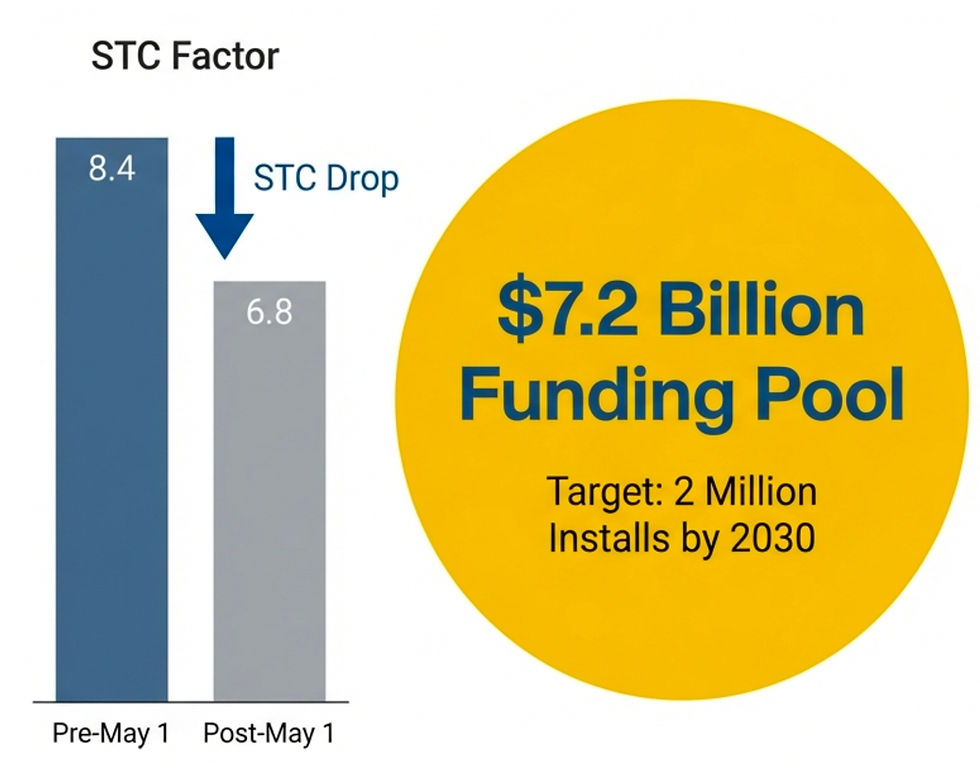
The Strategic Play: Because the install date determines the final calculation method and value, successful operators are using advanced scheduling to ensure their pipeline is delivered on time. By focusing on systems optimized for the new 14 to 28kWh tiers, businesses can maintain a compelling ROI for customers while adapting to the new policy landscape.
2: Delivering Maximum Customer ROI: The New Savings Frontier
In 2026, a customer's satisfaction and your future referrals will depend on one thing: Savings. As tariffs become more complex, the best system is no longer the biggest one, but the one configured most intelligently.

Mastering the Solar Sharer Offer: From 1 July 2026, the new Solar Sharer Offer (SSO) will provide at least three hours of free electricity during the middle of the day in NSW, SA, and South East Queensland.
Precision Configuration: To help customers unlock meaningful bill savings, systems must be configured with the right inverter settings and battery dispatch profiles. For instance, a family of five shifting 25 to 30 percent of their energy use to the free window could potentially see hundreds of dollars in annual savings.
The Service Advantage: Installers who provide ongoing guidance on load shifting—scheduling pool pumps, EV charging, and appliances to align with the SSO—will become trusted energy partners, not just contractors.
Scaling Effectively Amidst Labor Challenges

The Australian market now boasts over 4.2 million rooftop solar systems. However, thousands of these systems are now orphans—installations where the original provider is no longer around or the customer is looking for a more reliable service partner.
This represents a massive service opportunity. Instead of relying solely on new sales, smart businesses are capturing the existing market by providing high quality maintenance, health checks, and battery retrofits for these unmanaged systems. Turning an orphan system into a managed asset creates a new recurring revenue stream and a loyal customer for future upgrades
Scaling Effectively Amidst Labor Challenges
While the industry faces a projected shortfall of 32,000 electricians by 2030, businesses must focus on what they can control. Hardware pricing and supply remain changeable; therefore, labour efficiency and first time right installs are the primary levers for profitability.

Instead of adding overhead, leaders are turning to Service Management Automation. By automating the behind the scenes work, teams can handle higher volumes and service more sites with fewer truck rolls. This allows your senior electricians to focus on complex technical work while automation handles the routine performance monitoring and customer reporting.
The Digital Pivot: Automating for Success
The shift toward a service oriented model is being powered by digital automation. This technology allows installers to move from a reactive break fix approach to a proactive, revenue generating service model.

Remote Performance Triage: Automated diagnostics can identify if a system's underperformance is due to a simple setting mismatch or a physical fault. By identifying issues remotely, businesses save hundreds of dollars in unnecessary site visits.

Proactive Engagement: Automation allows you to send regular Energy Health Reports to your customers. These reports confirm that their battery is operating efficiently, keeping your brand top of mind for their next upgrade or referral.
Evidence Based Compliance: As Distribution Networks gain access to Power Quality Data (PQD) from smart meters starting 1 July 2026, you can show evidence your installations are operating as expected and troubleshoot voltage or quality disputes faster using PQD.
Conclusion: Partnering with SolYield
The 2026 market shift is the perfect time to calibrate your business for the next decade of growth. SolYield is the operational backbone designed to help you make this transition profitable and simple.

Maximise Savings: We provide the analytics to ensure your customers' inverter settings and battery profiles are always optimised for the latest tariffs, including the Solar Sharer Offer.
Service Revenue on Auto Pilot: SolYield helps you launch and manage solar and storage service packages with automated monitoring, reporting, and field operations.
Grow Referrals: We turn your existing customer base into an active referral engine through automated, branded reporting.
The future of Australian energy is intelligent, automated, and customer centric. With SolYield, you’re not just riding the coaster, you’re driving it.
Navigating the solar market requires the right tools and insights. SolYield Software empowers solar professionals to automate operations, maximise customer satisfaction, and grow their business profitably with confidence. If you’d like to learn more or schedule a demo, contact us @ info@solyield.com
Comments